

Why the Same Graft Count Can Look Completely Different on Two Patients

Dr. Gökay Bilgin & Dr. Mehmet Erdogan
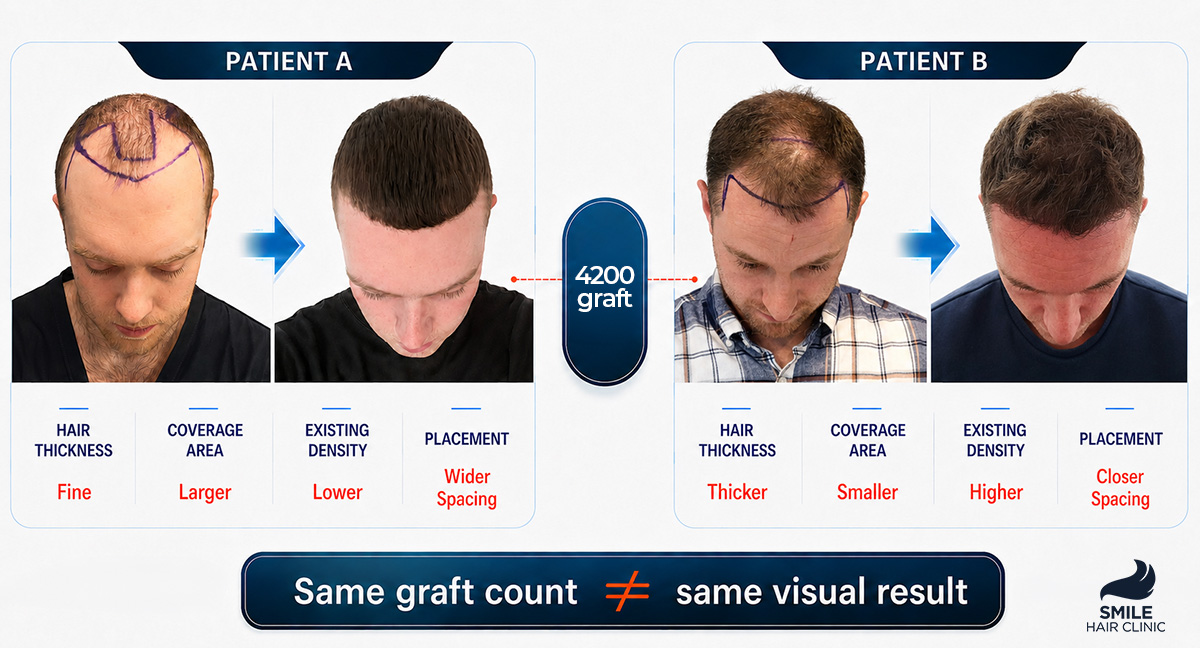
Why doesn't the same number of grafts produce the same result in everyone
Two patients may each receive 3,500 grafts yet achieve visibly different outcomes. According to Smile Hair Clinic, this does not necessarily indicate that one procedure was more successful than the other. Graft count is only one element of a much broader and highly individual treatment plan.
A graft is a naturally occurring follicular unit that may contain one, two, three or more hairs. This means that the same number of grafts does not automatically represent the same total number of transplanted hairs. One patient’s 3,500 grafts may contain a higher proportion of multi-hair follicular units, creating greater visual density than the same graft count in another patient.
Hair calibre is another important factor. Thick hair generally creates stronger visual coverage because each strand occupies more space, while fine hair may require a different distribution strategy to achieve a comparable appearance. Hair colour, curl pattern and the contrast between the hair and scalp can also significantly affect how dense the final result appears.
The Size of the Treatment Area Changes the Outcome
The same graft count may be concentrated within a limited frontal area or distributed across the hairline, mid-scalp and crown. When grafts are placed within a smaller area, the result can appear denser. When the same number is used to restore a larger area, coverage may improve considerably while the overall appearance remains more diffuse.
The patient’s original hair-loss pattern also influences the plan. A patient seeking frontal hairline restoration has different requirements from someone experiencing advanced thinning across multiple zones. In extensive cases, protecting the donor area and planning for possible future sessions may be more responsible than attempting maximum coverage in a single operation.
Hairline Design Is as Important as Graft Count
A natural-looking result depends on more than density. The position and shape of the hairline, the use of single-hair grafts at the front, and the angle and direction of implantation all influence how successfully the transplanted hair blends with the patient’s existing hair.
Smile Hair Clinic’s True™ Philosophy places individual analysis and planning at the beginning of the process. During True Planning, the medical team evaluates donor capacity, hair characteristics, the extent of hair loss and the patient’s long-term needs. True Hairline Design then focuses on aesthetic proportions and natural growth directions rather than applying the same design to every patient.
Techniques such as Sapphire FUE allow recipient sites to be created according to the planned angle, direction and distribution. DHI can provide close control over the depth, angle and direction of implantation in selected cases. The appropriate method should therefore be determined by the patient’s individual characteristics not by graft count alone.
Donor Quality and Long-Term Planning Matter
Every patient has a limited donor supply. Follicles extracted from the donor area do not regenerate in the place from which they were removed. Responsible planning must therefore balance the desired result with the preservation of donor resources for the future.
The quality of the donor area, the safe extraction limit, follicular-unit composition, hair thickness and the stability of ongoing hair loss must all be assessed before confirming a treatment plan. Transplanted hair may provide permanent growth, but the patient’s existing non-transplanted hair can continue to thin over time.
For anyone considering a hair transplant in Turkey, the most useful question is not simply, “How many grafts will I receive?” Patients should also ask where those grafts will be placed, how their donor capacity has been evaluated, which parts of the procedure involve a surgeon and how future hair loss has been incorporated into the plan.
Rather than relying solely on advertising claims about the best hair transplant in Turkey, patients should compare clinics using objective criteria such as medical accreditation, surgeon involvement, individualized graft planning, verified long-term patient results and structured aftercare.
These factors can determine whether a Turkey hair transplant produces a result that looks natural, balanced and appropriate for the individual patient not the graft number in isolation.
What Patients Should Ask Before a Hair Transplant
Before agreeing to a procedure, patients should request a detailed assessment rather than focusing only on the promised graft count. Important questions include:
•How many hairs are expected within the proposed number of grafts?
•How large is the recipient area that will be covered?
•What is the patient’s safe donor capacity?
•How will the grafts be distributed between the hairline, frontal area, mid-scalp and crown?
•Which technique is most appropriate for the patient’s hair type and hair-loss pattern?
•Who will perform the hairline design and the critical stages of the procedure?
•How has the possibility of future hair loss been included in the long-term plan?
•What type of follow-up and aftercare will be provided after the patient returns home?
A medically responsible plan may sometimes recommend fewer grafts, a more conservative area of coverage or a staged treatment. Protecting the donor area can be more important than achieving the highest possible graft number in a single session.
Individual Planning Creates Individual Results
Hair transplantation is not a standardised procedure in which the same number automatically produces the same visual outcome. Each patient brings a different combination of donor density, follicular-unit structure, hair thickness, hair colour, curl pattern, scalp contrast, hair-loss stage and recipient-area size.
For this reason, comparing two patients only through their graft counts can be misleading. A more accurate evaluation considers the patient’s starting point, the quality of the available donor area, the size of the treated area, the surgical plan and the maturity of the final result.
The objective should not be to transplant the largest possible number of grafts. It should be to use the patient’s available donor resources safely and strategically to achieve the most natural, balanced and sustainable result possible.
About Smile Hair Clinic
Founded in Istanbul in 2018 by medical doctors Dr. Mehmet Erdoğan and Dr. Gökay Bilgin, Smile Hair Clinic provides physician-led hair transplantation services for international patients. The clinic performs Sapphire FUE and DHI procedures under surgeon supervision and supports patients throughout consultation, treatment and aftercare.
Smile Hair Clinic is accredited by TEMOS International Healthcare Accreditation and has received its highest distinction, the A-Rated Certification, becoming the first and only hair transplant clinic in the world to achieve this rating.
The clinic’s approach is guided by its True™ Philosophy, bringing together detailed planning, personalised hairline design, careful execution and continued innovation. Smile Hair Clinic also provides multilingual patient assistance and structured follow-up support for patients returning home after their treatment.
Berk Elmas
Smile Hair Clinic
+ +90 549 149 24 00
email us here
Visit us on social media:
Instagram
Facebook
YouTube
TikTok
X
Legal Disclaimer:
EIN Presswire provides this news content "as is" without warranty of any kind. We do not accept any responsibility or liability for the accuracy, content, images, videos, licenses, completeness, legality, or reliability of the information contained in this article. If you have any complaints or copyright issues related to this article, kindly contact the author above.
